
Print on demand gets sold as the ultimate passive income dream. Upload a design, sit back, and watch the money roll in. The reality is far more nuanced, and the entrepreneurs who thrive are the ones who understand the mechanics, the risks, and the real profit drivers before they spend a single dollar. This guide cuts through the noise to give you a clear, honest picture of how print on demand works, what it takes to succeed, and what most beginner guides conveniently leave out.
| Point | Details |
|---|---|
| Low-risk e-commerce entry | Print on demand lets you start selling with minimal upfront investment and no need for inventory. |
| Margins and shipping matter | Lower profit margins and shipping delays are the real tradeoffs compared to bulk buying. |
| Quality control is critical | Always order product samples and use high-quality design files to avoid costly mistakes. |
| Algorithm challenges exist | New sellers face algorithm barriers; established stores and simple winning designs perform best. |
| Smart strategy wins | Careful niche validation, supplier diversification, and clear customer communication boost your success odds. |
Print on demand, often abbreviated as POD, is a fulfillment model where products are only created after a customer places an order. You never hold physical inventory. Instead, you upload your custom designs to a platform, list those products in your store, and when someone buys, your print partner produces and ships the item directly to the customer.
The most common POD products include t-shirts, hoodies, mugs, tote bags, phone cases, wall art, and posters. The appeal is obvious: you can sell dozens of product types without warehousing a single unit.
Here’s how POD compares to traditional bulk inventory retail:
| Factor | Print on demand | Bulk inventory |
|---|---|---|
| Upfront cost | Very low | High |
| Per-item cost | Higher | Lower |
| Profit margin | Typically 15-30% | Can reach 40-60%+ |
| Quality control | Relies on print partner | Direct oversight |
| Shipping speed | Slower (production + shipping) | Faster (pre-made stock) |
| Risk level | Low | Higher |
| Flexibility | Easy to test new designs | Committed to existing stock |
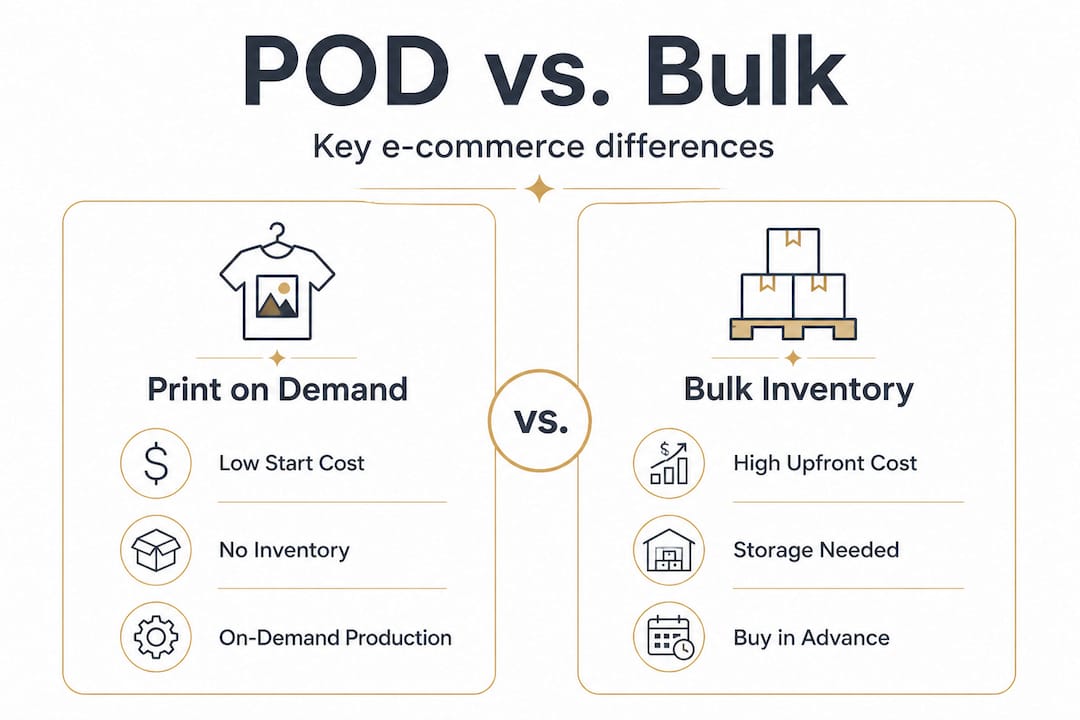
The key tradeoff is clear: POD reduces your financial risk dramatically, but you give up margin and control in exchange. This is not a flaw in the model. It is simply the cost of operating without inventory.
Key benefits of print on demand include:
However, lower margins vs bulk and quality control reliance are real challenges that trip up newcomers. Many sellers discover these issues only after customer complaints start arriving.
Pro Tip: Before you list a product publicly, calculate your actual profit per sale. Include the base product cost, platform fees, payment processing, and any advertising spend. Many sellers are shocked to find they’re netting under $3 per shirt after all costs.
With the basics covered, let’s walk through the actual process so you know what to expect at every step.
1. Choose your niche and validate it
Before creating a single design, research whether there is an actual audience for your product idea. Use keyword tools, browse marketplaces, and look at what’s already selling. Niche validation is the step most beginners skip, and it’s the one that costs them the most time.
2. Create your designs
Your design files need to meet specific technical standards. Always work at 300DPI (dots per inch, the resolution standard for print quality) and use CMYK color mode (Cyan, Magenta, Yellow, Key/Black, which is the color system used in physical printing). Files submitted in RGB (the color mode used for screens) often print with noticeably different colors than what you see on your monitor.
3. Set up your store and product listings
Upload your designs to your chosen POD platform, configure product variants (sizes, colors), write compelling product descriptions, and set your pricing. Your listing quality directly affects conversion rates.
4. Customer places an order
When a buyer purchases from your store, the order details are automatically or manually relayed to your print partner. Most modern POD integrations handle this automatically.
5. Print partner produces and ships the item
Your print partner prints the design, packages the product, and ships it directly to your customer, usually with your branding if you’ve set that up. You never touch the product.
6. Customer receives the order
Delivery times vary. Most POD fulfillment ranges from 2 to 10 days for production alone, before shipping transit time is added. Set accurate expectations in your store to avoid negative reviews.
A few critical nuances that expert sellers emphasize:
Pro Tip: When you receive your sample, photograph it in natural light and compare it side by side with your digital mockup. Look for color accuracy, print placement, and fabric feel. If it doesn’t meet your standard, switch suppliers before you list publicly.
Knowing the process, it’s critical to weigh both the upsides and the realities of print on demand before committing time and money.
Here’s a direct comparison of the major pros and cons:
| Advantage | Pitfall |
|---|---|
| Low financial risk to start | Lower profit margins per sale |
| No inventory storage needed | Less control over production quality |
| Easy to test new designs quickly | Longer fulfillment and shipping times |
| Creative freedom and brand building | High market saturation in popular niches |
| Scalable without large capital | Algorithm disadvantage for new sellers |
| Global product reach | Customer service burden for delivery issues |
The advantages are real and meaningful, especially for first-time entrepreneurs who can’t afford to buy $5,000 worth of inventory upfront. But the pitfalls deserve equal attention.

Shipping delays are a bigger problem than most guides admit. When a customer orders a t-shirt expecting Amazon-speed delivery and receives it two weeks later, they don’t blame the print partner. They blame your store. Managing customer expectations upfront, through your product pages and confirmation emails, is not optional. It’s a core part of running a POD business responsibly.
Market saturation is a genuine barrier. Certain niches like generic motivational quotes on shirts or basic dog-lover mugs are so flooded that a new seller has almost no chance of organic visibility. The algorithm barriers for new sellers on platforms like Etsy or Amazon Merch are real. Established sellers with hundreds of reviews and years of sales history rank far above new listings, even when the new product is objectively better.
Some additional realities to factor into your planning:
Studying successful best sellers in your target niche before launching can give you a realistic benchmark for what’s actually working in today’s market, rather than what worked two years ago.
Statistic callout: Studies from e-commerce communities consistently show that the majority of new POD sellers abandon their stores within the first six months, most often citing poor sales volume and unexpectedly low margins as the primary reasons.
Now that you know the tradeoffs, let’s get practical about how you can actually succeed in today’s competitive POD landscape.
Design simplicity wins more often than complexity. This is counterintuitive for creative entrepreneurs who want to showcase elaborate artwork. But buyers make split-second decisions. A clean, bold design with a clear message converts better than a detailed illustration that looks great zoomed in but becomes unreadable as a thumbnail. Keep your designs focused on one to two core elements and make sure they’re legible at small sizes.
Niche specificity beats broad appeal. “Dog lover” is a category. “Golden retriever owner who does yoga” is a niche. The more specific your target audience, the less competition you face and the more your products feel personally relevant to buyers. Specific niches also tend to have passionate communities who actively seek out merchandise.
Algorithm advantages go to established sellers. This is not a reason to give up. It is a reason to build your own traffic sources rather than relying entirely on marketplace algorithms. Investing in content creation essentials and building an audience through social media growth strategies gives you a channel that you control, independent of any platform’s ranking system.
Set honest shipping expectations everywhere. Put your production and shipping timeframes on your product pages, in your FAQ, and in your order confirmation emails. Buyers who know what to expect are far less likely to leave negative reviews or file disputes. Clear communication is one of the cheapest forms of customer service you can offer.
Diversify your supplier relationships. Using two or three print partners for different product types, or as backups for your primary products, protects you from supply chain disruptions. A single supplier outage can cost you weeks of sales and damage your store’s reputation with delayed orders.
“The sellers who last in print on demand are not the ones with the most creative designs. They’re the ones who treat it like a real business: testing systematically, managing customer expectations, and building their own audience.”
Effective client management tips apply here too. Responding promptly to customer inquiries, handling complaints professionally, and following up after delivery all contribute to the review scores that determine your long-term visibility.
Pro Tip: Run a small paid ad test on your top three designs before investing heavily in any single product. Spending $20 to $30 on targeted traffic will tell you far more about real-world demand than any amount of niche research alone.
Most POD guides are written to inspire you to start, not to prepare you for what comes after. That’s a disservice to entrepreneurs who deserve an honest picture.
Here’s what we’ve observed consistently: entry into POD is genuinely easy. Creating an account, uploading a design, and listing a product takes less than an hour. But easy entry is not the same as easy success. The saturation and algorithm barriers that new sellers face are not theoretical. They are the daily reality for anyone launching a new store on a competitive marketplace in 2026.
The algorithm problem is particularly worth understanding. Platforms like Etsy and Amazon Merch use sales history, review counts, and conversion rates to rank listings. A new store with zero reviews competes directly against stores with thousands of five-star ratings and years of data. The platform has every incentive to show buyers the proven seller over the new one. This is not unfair. It is just how these systems work. Knowing this means you should not plan your entire business around organic marketplace traffic in your first year.
Quality and delivery issues are not edge cases. They happen regularly, and when they do, the customer’s frustration lands on your store, not your print partner’s. We’ve seen sellers lose their Etsy accounts over a string of delivery complaints that were entirely caused by a supplier’s production backlog. Your supplier’s problems become your problems the moment a customer clicks buy.
The sellers who navigate saturated markets successfully share a common trait: they treat POD as a business that requires ongoing management, not a system that runs itself. They test designs, study data, communicate with customers, and adapt constantly. The “set it and forget it” version of POD exists mostly in marketing copy, not in the experience of real sellers.
Anyone can start a print on demand store. Far fewer can scale one profitably. The gap between those two outcomes is filled almost entirely by experience, adaptability, and the willingness to treat every failure as a data point rather than a reason to quit.
You now have a clearer picture of what print on demand actually involves, from the workflow and profit mechanics to the real challenges that most beginner guides gloss over. The next step is putting that knowledge into action with the right tools and resources behind you.

At Eliteris, we’ve built a resource hub specifically for e-commerce entrepreneurs who want to move beyond theory and into execution. Whether you’re looking to study best sellers to identify what’s actually converting in your niche, or you need business marketing resources to build the audience and traffic your store needs to grow, we have curated tools and guidance designed for exactly where you are right now. Start with what you know, build on what works, and use every resource available to shorten your learning curve.
Print on demand can be profitable, but it requires careful niche selection, strong marketing, and smart pricing since margins are lower compared to buying inventory in bulk. Sellers who treat it as a real business rather than passive income tend to see the best results.
Most POD suppliers require 2 to 10 days for production before shipping transit time is added, so total delivery can range from one to three weeks depending on the destination.
The most frequent mistakes include skipping sample orders, submitting low-resolution design files, depending on a single supplier, and failing to communicate realistic shipping timelines to customers upfront.
Basic design skills are helpful, but research consistently shows that simpler designs sell best, meaning clear messaging and strong niche fit matter more than artistic complexity.










Leave a comment